
The Arthur Sleep glossary
The language
of shoemaking.
From the first cut to the final polish. Explore the shapes, materials and small details that make a shoe.
Explore the glossary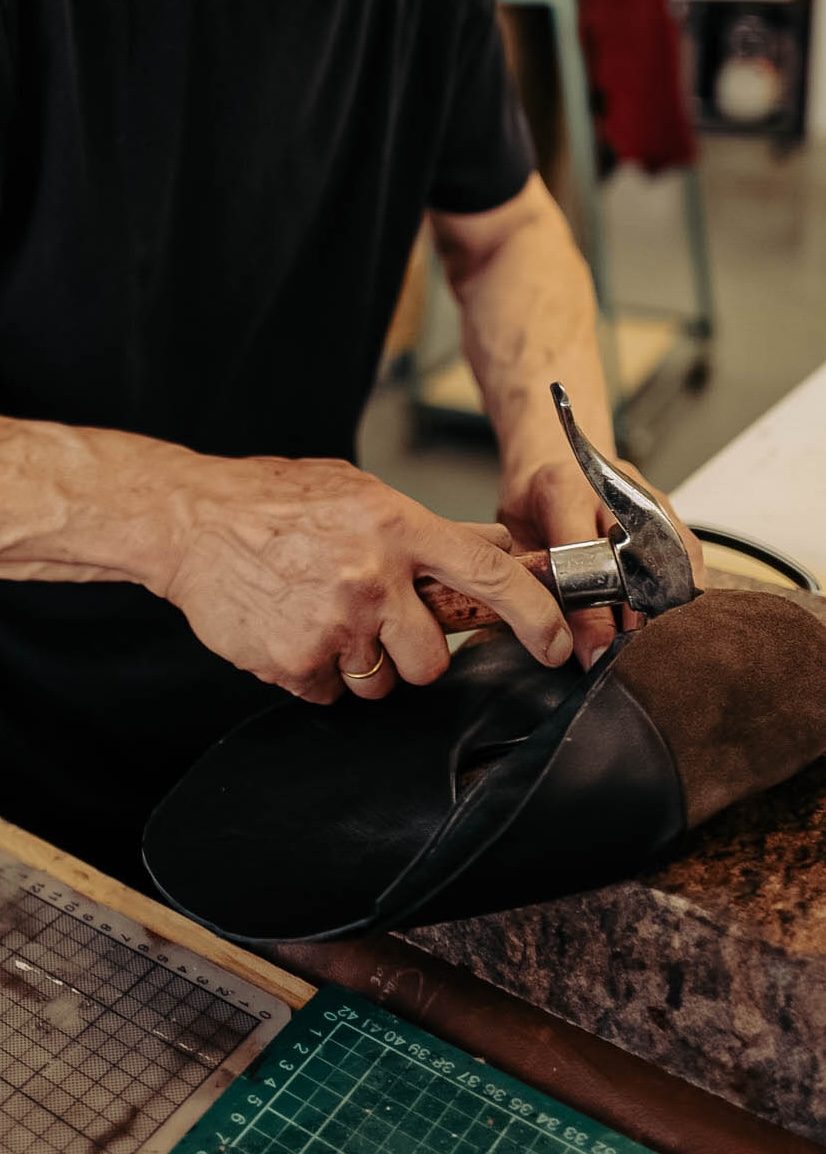
No terms found.
Try a shorter word, or explore another category.
Shoemaking has a language of its own. If you are not sure of an oxford from a brogue, start with these 12 terms. The full glossary below has the rest.
12 key shoe terms
- Cordwainer: The traditional name for a shoemaker. It comes from cordwain, or cordovan, a Spanish leather from Córdoba that was used for shoes.
- Oxford: A closed lace-up shoe. The eyelet tabs are stitched under the vamp.
- Brogue: A lace-up shoe decorated with perforations and pinked (saw-toothed) edges.
- Derby: A lace-up shoe with open eyelet tabs, stitched on top of the vamp.
- Slipper: A light shoe that slips on and off easily, often made in velvet, wool or silk.
- Last: The form over which the upper is shaped. A bespoke last is carved to the shape of one person’s feet. Ready-made shoes use a standard last for each style.
- Quarters: The sides of the upper. They join the vamp at the front and are seamed together at the back. A pair of shoes has four of them, hence the name.
- Upper: The part of a shoe or boot that covers the top of the foot. Depending on the style, it can be made up of the toe cap, vamp, tongue, quarters and back.
- Vamp: The front of the upper, covering the toes and part of the instep.
- Shank: A reinforcement at the waist of the shoe, between the sole and the insole.
- Insole: The sole the upper is attached to and the foot rests on. The outsole is added underneath.
- Sole: The underside of a shoe or boot, which rests on the ground.
Shoemaking and shoe parts
A
Addition method
A way of fitting a bespoke last. Where the foot is broader than average, or the instep or big toe higher, or the heel thicker, the shoemaker corrects the last by attaching pieces of leather to it. A shoe can be made on this corrected last, but it is better to make a final last from it by fine copying.
Apron front
A shoe front with a shield-shaped ‘apron’, set under or over the vamp and outlined with visible stitching. The style comes from the moccasin, where the apron sometimes forms the top of the upper.
Arch supports
Supports for the arch of the foot. Fallen arches can be helped with supports at an early stage, so the shoemaker looks closely at the state of the arches.
Artois buckle
A large shoe buckle, popular in the 1770s and 1780s.
Awl
A pointed tool for making holes. The shoemaker uses a long awl to make the stitch holes in the welt, and a short one to make the holes for the wooden pegs in the rand.
Awl holes
Square holes made with the awl for the wooden pegs that attach the rand. The holes are sealed with adhesive at the end.
B
Back stiffener
A leather reinforcement inside the shoe, where the quarters meet.
Back strap
A strip covering the seam that joins the quarters at the back of a shoe or boot.
Basic forme
The pattern used to design the upper. The designer transfers the design from the last onto paper.
Bead
A strip of material inserted into a seam of the upper to reinforce it. When it is set into a sole seam, it is called a welt.
Blake welting
A stitched construction in which the upper is sewn straight to the sole from inside the shoe. It is less water resistant than a Goodyear welt but more flexible, and because it is simpler it usually costs less. The Blake stitching machine was invented in 1856, and the construction is common in Italian shoes.
Breast
The front face of the heel, usually called the heel breast.
Breasting iron
A shoemaker’s tool, made in several cross-section sizes, for smoothing the edges of the sole and heel and making the leather denser.
Brogueing row
A line of holes, of the same or different sizes, punched at regular intervals along the lines and curves where the parts of the upper meet.
Burnishing iron
An iron tool that the shoemaker heats over a flame and uses to press ink and shoe cream into the leather.
C
CAD/CAM
Computer-aided design and computer-aided manufacture. Most shoe manufacturers now design and make their shoes with CAD/CAM.
Cap
A separate part of the upper, over the toes. It may be straight, peaked or winged, or a combination of the last two.
Chape
The pronged part of a buckle, through which the strap is fastened.
Clicker
The person who cuts out the parts of the upper.
Clicking
Cutting the parts of the upper from the leather, following the style formes.
Closed tab
An upper pattern in which the eyelet tabs are stitched down to the vamp, as on an oxford.
Closer
The person who stitches the parts of the upper together.
Closing
The stage of shoemaking in which the parts of the upper are stitched together.
Closing shop
The workshop where the parts of the upper were traditionally reinforced and stitched together. Today uppers are often made industrially and supplied to the shoemaker.
Clump or clump sole
A half sole, usually added to a shoe as a repair.
Cobbler
A person who repairs shoes. The industrial revolution turned many shoemakers into cobblers, as machines took over the making of shoes.
Cobbler’s hammer
A hammer of about 18 ounces (500 g), similar to a household hammer, with many uses.
Collar
A thin, rolled strip of leather that reinforces and decorates the top of the quarters.
Cordwainer
The traditional name for a shoemaker. It comes from cordwain, or cordovan, a Spanish leather from Córdoba that was used for shoes.
Counter
Another name for a stiffener, though strictly an ‘outside counter’: a separate piece placed over the back of the quarters.
Cuban heel
A fairly straight-sided heel, broader at the base than the Spanish heel.
Currying
Dressing leather, as part of the tanning process.
Custom-made shoes
Shoes made by hand to fit one person’s feet, from the measurements taken of them.
D
Direction of stretch
The way the upper leather stretches, which decides how the formes are placed. The forme for the vamp, for example, must be placed so the leather can stretch along its length but not across it. If the quarters can stretch lengthwise, they will give by two-fifths to four-fifths of an inch (1 to 2 cm), and the shoe will lose its shape and fit.
E
Eyelet
A hole for a lace. By convention the word is kept for holes with a metal or plastic binding. Where the binding shows only on the inside, it is a blind eyelet. Other holes are lace holes or stitched lace holes. Thomas Rogers patented the first machine for metal eyelets in 1823.
Eyelet tab
See Facing.
F
Facing
The front of the quarters, which carries the eyelets. Sometimes called the eyelet tabs.
Filling
Material that fills the gap in a welt-stitched shoe. It absorbs shock and steadies the sole as you walk.
Fine copying
A last-making method in which a machine transfers the measurements of the last forme exactly to the new last. It is also the method in which a last corrected by the addition method serves as the last forme.
Finishing
The final stage, once the shoe is made. The upper is washed, creamed and polished, and the edges of the sole and heel are inked, heelballed and polished. The edge iron presses the sole edge, the dummy iron smooths the heel edge, and both are then patterned with the fancy wheels. The top piece and sole are creamed or inked.
Finishing wax
A wax the shoemaker applies in a thin coat to the upper after inking. It is then pressed into the leather with the ink, using a warm iron.
Flesh side
The side of the skin that faced the animal’s body. Since the eighteenth century it has been used for rougher, everyday footwear, as scuffs and scratches show less.
Foot arch
The arch of the foot, running both along and across it. It carries the body’s weight when standing and walking, and absorbs shock, so less of the impact reaches the head and spine.
Foot documentation
Everything important about the feet and their owner, gathered when the measurements are taken: the measurement record, the foot imprint, draft drawings and marked-up lasts.
Foot elevation
The side and rear view of the foot, drawn onto paper.
Foot imprint
An imprint of the foot made with a Ped-a-graph. It shows the arch, the points where the curves of the arch meet, and the position of the toes.
Foot outline
An outline of the foot, drawn on paper with a pencil held upright. The length and width of the shoes are measured from it.
Forepart
The front of the shoe, sole or insole.
Foxing
An American term for the leather pieces that form or cover the vamp or back of a wool serge gaiter boot.
G
Gimping
Trimming and decorating the edges of leather pieces at the same time. The shoemaker does this with a gimping machine, which takes steel tools in different patterns.
Girths
The measurements around the foot, taken at the metatarsals, the instep, the heel and the ankle.
Goodyear welting
A stitched construction in which a leather welt is sewn to the insole by machine and the sole is then stitched to the welt. This makes the shoe easy to resole. The process was invented in 1896 by Charles Goodyear Jr, son of the American inventor Charles Goodyear.
Grain
The outer surface of the leather, which once carried the animal’s hair, fur or wool. Each animal has its own grain pattern, and the surface is usually smooth. Soles usually have the grain side down, on the ground, and insoles the grain side up. Uppers normally have the grain side out, except in suede. Since the eighteenth century the grain side has been used for better footwear.
H
Half sole
A short sole under the forepart that does not reach the heel. It is usually a repair, either replacing a worn forepart sole that has been cut away or added as a clump.
Heel
The solid base under the back of the foot. It is usually a wooden block covered in leather or fabric, or built up from layers of leather. Either way, the part that rests on the ground is the top piece.
Heel breast
The front face of the heel, facing the arch of the foot.
Heel construction
A heel is built from several leather lifts, a top piece and a quarter rubber.
Heel cup
A piece of leather, part of the upper, on the outside of the back of the shoe, covering the seam that joins the quarters. It may be a narrow strap or a long vertical piece in line with the heel.
Heel edge
The outer surface of the heel. It is usually black, but is sometimes coloured to match the upper. Left uncoloured, the separate lifts can be seen.
Heel grip
A small strip of leather or suede inside the back of a shoe that helps the shoe stay on the foot.
Heel lifts
Two to four pieces of leather cut to the shape of the heel, which together make it up.
Heel section
The back of the shoe.
Hobnail
A nail with a large head, usually domed, used to protect the sole.
Hose
A textile covering for the leg and foot.
I
Inner sock
The leather lining in direct contact with the foot. The customer can ask for it to cover the whole insole, three quarters of it, or only the quarter under the heel. See also Sock.
Insole
The sole the upper is attached to and the foot rests on. The outsole is added underneath.
Instep
The raised part of the top of the foot, between the toes and the ankle.
L
Lace
A length of leather, silk ribbon or braided cotton, threaded through holes to fasten a shoe.
Lacing
Straight, horizontal lacing is typical of the oxford and looks more formal. Criss-cross lacing is typical of the derby and looks more casual. Either can be chosen for any shoe.
Lacing hooks
Hooks made from narrow strips of metal with rounded ends, fixed to the latchets of a boot. The laces wind around them instead of passing through eyelets. They were first patented in 1865.
Last
The form over which the upper is shaped. A bespoke last is carved to the shape of one person’s feet. Ready-made shoes use a standard last for each style.
Last removal
Taking the last out of the finished shoe. The shoemaker pulls it out carefully with an iron hook about a quarter of an inch (6 to 7 mm) thick, controlling the pressure with the foot strap.
Last type
The last type sets the shape of the shoe. Types differ in the shape and width of the vamp. It is the shoemaker’s job to choose the right type of last for each client.
Laster
The person who shapes the stitched upper over the last.
Lasting
Nailing the upper to the insole on the last. From this point the last gives the upper its three-dimensional shape.
Latchets
The parts of the upper over the instep that carry the eyelets for the laces, usually over a tongue. They are extensions of the quarters, and are sometimes called lacing tabs or eyelet tabs.
Leg
The part of a boot that covers the ankle and above.
Lining
The inside of the upper, usually divided into the same parts as the outside: vamp lining, quarter lining and leg lining.
Lining leather
Vegetable-tanned leather, on average one-twentieth of an inch (1.2 mm) thick, used to line the shoe. It is soft, but also hard-wearing.
Louis heel
A heel whose front face (the breast) is covered by a downward extension of the sole. It curves in sharply at the back and flares at the base.
M
Mark
A cut made in the top sole for the top-sole seam.
Measurement taking
Recording the important measurements of the foot, to make up the foot documentation. It should be done at a time when the feet are in an ideal state.
Middle sole
A sole between the welt and the top sole, found on double-soled shoes.
Middle-sole seam
The seam that holds the welt and the middle sole together.
O
Open tab
An upper pattern in which the eyelet tabs are left loose over the centre front of the vamp, as on a derby.
P
Paste
A mix of wheat starch, dried chestnut or potato, and water. It stiffens and strengthens.
Patina
The colour and soft sheen that leather takes on as it ages, oxidises and absorbs oils.
Peg
A strip of wood used for rough heel repairs. Early pegs for heels were oval in section. In the nineteenth century pegs were also used to attach soles, and were usually diamond shaped.
Pinchbeck
A copper alloy made to look like gold.
Pinking
The saw-toothed leather edge often seen as decoration on brogues. In the sixteenth century the word also meant cutting zig-zag edges and patterns into leather. The twentieth-century term ‘gimping’ is also used for the zig-zags on brogues.
Polisher
The person who finishes a shoe: trimming the sole, staining its edge and polishing the leather.
Putting-on brushes
Soft horsehair brushes for applying shoe cream. Use a separate brush for each colour.
Q
Quarter rubber
A piece of hard, non-slip rubber, a quarter of an inch (6 mm) thick, nailed to the top piece of the heel.
Quarter tip
A piece set into the top piece at the outside back of the heel, where it wears first.
Quarters
The sides of the upper. They join the vamp at the front and are seamed together at the back. A pair of shoes has four of them, hence the name.
R
Rand
A narrow strip of leather set between the upper and the sole. It can also be called a welt.
Removal method
A way of fitting a bespoke last. Where the foot is narrower or the instep flatter than average, the shoemaker takes wood away from the last.
Repair service
Any good shoemaking workshop offers one. Used regularly, it gives shoes a long life. Ours is called recraft and resole.
Rivet
A metal nail driven through the sole against an iron, or an iron-plated last, so that its point turns back on itself and cannot work loose.
Rough copying
A machine roughly transfers the measurements from the forme to a block of wood, making the rough last.
Rubber solution
Rubber dissolved in benzene. This adhesive dries in 10 to 15 minutes and stays flexible and springy when dry.
S
Sandpaper
Paper with a rough surface, from coarse to fine, used to smooth edges.
Screw stretcher
A device for widening shoes by hand.
Seat or heel seat
The back end of the insole or sole, where the heel of the foot rests.
Sewing thread
Cotton or strong linen. Silk is used to stitch very fine parts of the upper. Thread for uppers has three, four, six or nine strands. Its fineness depends on its length in metres and its weight in grams. The thread should be one shade darker than the upper leather.
Shank
A reinforcement at the waist of the shoe, between the sole and the insole. It stops the shoe bending at the waist, especially when there is a heel.
Shoe assembly
The stage of making in which the insole is nailed to the last and joined to the edge of the upper, the welt and the top sole are sewn on, and the heel is built.
Shoe horn
A tool of wood, horn or metal that lines and stiffens the back of the shoe while the foot slips in. Short shoe horns are for shoes, long ones for boots and ankle boots.
Shoe trees
Wooden forms shaped like a last, which keep shoes in shape. The two usual designs are the three-piece shoe tree and the sprung shoe tree.
Shoe-care set
Everything needed to look after handmade shoes: cleaning brushes, putting-on brushes, creams, cloths and polishing brushes. Every owner of handmade shoes should have one.
Shoemaker’s knife
A steel knife with a slightly curved blade, for cutting the lower parts of the shoe (the sole and heel lifts), which are a quarter to a third of an inch (6 to 8 mm) thick.
Shoemaker’s tape measure
A non-stretch textile tape, marked in French stitches on one side and in metric units on the other.
Side linings
Narrow pieces of leather, cut from the same hide as the upper, placed between the upper and the lining and between the toe cap and the heel cup. They stop the leather stretching and strengthen both sides of the shoe.
Size
A number for the length of the shoe. Several systems are in use: French, English, American and metric.
Skiver
A small, sharp plane with a guide channel, used to shave away protruding leather a fraction at a time and to match up the edges of the sole and heel.
Skiving
Thinning the edge of leather so it can be seamed.
Sock
A piece of fabric or leather covering the insole inside the shoe. A heel sock covers only the heel end. It hides nail points and stitches, and may carry the maker’s name.
Sole
The part of the shoe that touches the ground. If the shoe has a separate heel, the part of the heel that touches the ground is the top piece.
Sole edge
The edge of the welt and top sole, or of the welt, middle sole and top sole.
Soling
Sticking and sewing the top sole, cut from bend leather, to the welt.
Spanish heel
A heel in which a single lift is inserted between the sole and the upper.
Specification sheet
A written form that gives a factory the designer’s exact measurements and design details for mass production.
Spring heel
A heel in which a single lift is inserted between the sole and the upper.
Spur leather
A butterfly-shaped piece of leather stitched to the front of a boot. A spur could be attached to it, and it protected the softer leather beneath.
Stacked heel
A heel built from several lifts (pieces of leather).
Steel plate
Often used instead of a quarter rubber, for better grip on slippery ground.
Stiffeners
A reinforcement inside the back of the quarters.
Stitching-channel flap
The leather lip left when material is pared away from the mark. It covers the top-sole seam, which would otherwise touch the ground and wear away quickly, until sooner or later the sole came loose.
Stretcher
A metal device for widening shoes.
Style collection
A collection of shoe styles shown in the workshop’s showroom.
Style design
A drawing of the shoe to be made, on the last itself, with its decoration, seams and the shapes of its parts. It lets the design be judged in three dimensions.
Style designer
The person who designs the shape and decoration of the upper, the proportions of its parts, and its colours and materials. The style designer works from classical traditions and keeps adding new elements to them.
Style forme
A pattern for the parts of the upper. It shows where the parts meet, their size, and every line, curve and decoration. The individual patterns for each part are made from it.
T
Tab
An extension of the vamp over the instep, like a tongue. ‘Lacing tabs’ is another name for latchets.
Tag
The metal or plastic tip on the end of a lace. It stops the lace fraying and makes it easier to thread through the eyelets.
Taking-off brushes
Polishing brushes made from the tail or mane hair of a horse. Use a separate brush for each colour.
Tanning pits (pit tanning)
Lined oak or cement pits for vegetable tanning. Skins are laid in the pit in layers, alternating with plant extracts, covered with tanning liquor and left to soften for a set time.
Throat
The centre of the front edge of the vamp, resting on the instep.
Toe cap
A separate piece over the toe of a shoe, joined to the vamp. A winged toe cap has its sides extended back towards the heel. A peaked toe cap has its centre extended to a point towards the instep.
Toe cap, internal and external
The internal toe cap is a leather stiffener at the toe of the shoe. It is also used in shoes with a one-piece upper, where you cannot see whether the shoe has one. If the vamp is divided, the toe cap can be straight (semi-brogue) or winged (full brogue). The external toe cap is the part of the upper that matches the internal toe cap in shape.
Toe puff
A reinforcement under the toe end of the vamp.
Tongue
A leather flap attached inside or outside the upper, which protects the lacing area from rubbing, pressure and anything getting in. It is often decorative too.
Top edge
The top of the upper.
Top piece
The final layer of the heel. A shoe is built upside down on the last, so this layer goes on top. When the shoe is worn, it rests on the ground.
Top-sole seam
The seam that joins the welt to the top sole on single-soled shoes, and to the middle and top soles on double-soled shoes.
Trial shoe
A shoe made in medium-quality leather on the bespoke last. If it fits poorly in places, the last can be corrected.
Turn welt
A turnshoe with an extra-wide rand sewn into the seam, which then serves as a welt for attaching the sole.
U
Upper
The part of a shoe or boot that covers the top of the foot. Depending on the style, it can be made up of the toe cap, vamp, tongue, quarters and back.
Upper features
Parts that reinforce or decorate the upper: linen lining, eyelet facing with underlay, collar and lining leather.
Upper reinforcers
Leather or textile stiffeners for the parts of the upper where there is a real risk of stretching.
V
Vamp
The front of the upper, covering the toes and part of the instep.
Vamp wings
The sides of the vamp that extend back on either side of the throat to join the quarters.
Vulcanisation
Hardening rubber by heating it with sulphur, which bonds with it chemically. This makes it stronger and more elastic.
W
Waist
The narrow middle of the sole, under the arch of the foot.
Walled toe
A toe where the vamp or toe cap rises straight up and then turns sharply to cover the instep.
Wedge heel
A heel that runs under the waist of the shoe to the forepart.
Welt
A narrow strip of leather sewn around the lasting margin of the upper, joining it to the edge of the insole or to a ‘rib’ raised on the flesh side of the insole near its edge. The sole is then attached to the welt with a second seam. Welts seem to have developed from the rand, and the two names are sometimes confused.
Welt construction
Two layers of sole (the insole and the outsole) joined to the upper by two seams and a leather welt.
Welt needles
Curved needles just over 3 inches (8 cm) long. The welt-stitching process needs two of them.
Welt seam
The seam that holds the upper, insole and welt together.
Wheeling
Running an iron wheel over the sole seams to seal them. The result is usually ridged, but decorative patterns are sometimes made.
Width numbering
A system of 5 to 8 girth measurements. From the shoe size and the width number, the girths at the metatarsals, instep, heel and ankle can be worked out.
Wing cap
A heart-shaped toe cap whose line runs along the vamp almost to the heel.
Shoe types
A
Adelaide
A side-laced boot with a leather toe cap, named after Queen Adelaide, wife of William IV.
Albert
A man’s slipper with a straight top line to the quarters and a vamp that rises into a tongue resting on the instep.
Albert boot
A side-lacing boot with five buttons and, usually, a cloth top.
Ankle boots
Boots for cooler days, reaching 2 to 4 inches (5 to 10 cm) above the ankle bone and fastened with eyelets, hooks or buttons. Their double soles give the feet extra protection.
B
Ballerinas or ballet flats
The ballet flat goes back to eighteenth-century France, but it was first worn outside the dance studio in the 1940s. In 1941 the Italian ballet shoemaker Salvatore Capezio made a street version of his soft ballet shoes for the designer Claire McCardell. In 1956 another Italian shoemaker, Rose Repetto, made ballet-inspired flats for Brigitte Bardot in ‘And God Created Woman’. After the film, ballet flats became a staple for women across Europe and North America.
Balmoral
A lace-up boot with a galosh: the vamp and quarters are cut in one piece, with a seam at the back. Queen Victoria made it popular, wearing it at Balmoral, her Scottish castle. In America the word also means an oxford shoe.
Bar shoe
A shoe with a low-cut vamp and a strap across the instep, fastened with a button or buckle. From the early 1900s, closed shoes with a single bar or strap came to be called Mary Janes.
Barette
A shoe or boot with two or more straps or bars.
Belgian loafer
A loafer in soft leather with a teardrop-shaped apron on the vamp. It is based on a shoe made in Belgium for over 300 years, and was popularised in the 1940s by the American entrepreneur Henri Bendel. Popular in New York in the 1960s, it was a classic around the world by the 1980s.
Boots
Any covering for the foot that reaches above the ankle.
Brogue
A lace-up shoe decorated with perforations and pinked edges. A brogued look can be given to styles with fewer sections by punching and gimping, as in the ‘London brogue’ and the ‘brogued oxford’.
Brothel creepers
Shoes, usually in suede, with a thick crêpe sole.
Budapest
A full brogue derby with a high toe cap.
Bulldog or Boston toe
A bulbous toe shape on men’s and women’s shoes, popular in the United States at the end of the nineteenth century and in the United Kingdom in the early twentieth.
Buskin
A soft leather boot reaching to the calf or knee.
C
Caliga
An open-toed sandal worn by the Romans, usually with a hobnailed sole.
Cambridge
A low-cut slipper with an elastic gusset on each side.
Chelsea boot
An ankle boot with elastic sides.
Chopines
Shoes on a very high platform, fashionable in Spain and Italy from the late fifteenth to the early seventeenth century. The name comes from the Spanish ‘chapín’, the cork-soled platform of the Spanish version. In Italy, where the platforms were made of wood, they were also called ‘calcagnini’ or ‘pianelle’. Some reached more than 54 cm (20 inches) high.
Clogs
A shoe, boot or overshoe made of wood or with a wooden sole, including styles with uppers of leather or other materials, and other shoes that protect the wearer from wet and dirty streets.
Congress
An American term for a boot or shoe with elastic side gussets.
Co-respondent shoe
A shoe in two colours of leather, usually white and tan, popular in the 1920s and 1930s.
Court shoe
A shoe with a low-cut vamp and no fastening, which slips on and off.
Cromwell
A shoe with a high vamp and a tongue or tab on the instep, usually with a buckle or similar trim. It is inspired by seventeenth-century styles and named after Oliver Cromwell, the parliamentary leader.
D
Derby
A lace-up shoe with open eyelet tabs, stitched on top of the vamp. The women’s derby is often called a Gibson or a Lorne shoe.
D’Orsay shoes
Usually heeled shoes with a low-cut vamp and the quarters cut away at the sides, showing the arch of the foot.
Double-stitched shoe
A handmade shoe with one sole and two rows of stitching, or two soles and three rows, all visible from the outside. It is a strong, casual shoe. There are two common versions: in one, the welt runs from one edge of the heel to the other; in the other, the welt also goes around the heel, so the heel is wider than usual. It suits strong smooth leather or leather with a rough surface, and is often made in more than one colour. Versions that cover the ankle are popular, as are boots.
Duckbills
A modern name for the wide-toed shoes fashionable in the first half of the sixteenth century. Some had small horn shapes at each side of the toe, widening it further. The vamps were usually slashed to show the wearer’s coloured hose underneath.
E
‘Eared’ shoe
In the sixteenth century, after a long period of pointed shoes, toes became very square and wide. For a short time, from about 1535 to 1555, the corners of the toe were drawn out sideways, like ears.
F
Full brogue
A shoe decorated with perforated patterns, with a winged toe cap and rows of perforations.
G
Gaiter boots
An American side-lacing or elastic-sided boot in wool serge, with leather foxing on the vamp.
Gaiters
Cloth or leather coverings for the ankle and leg. They may be buttoned or buckled, and sometimes have straps that go under the foot.
Galosh
A construction in which the vamp is cut in one piece with the quarter and seamed at the back. Also an overshoe, first of leather or fabric and now usually of rubber.
Ghillie
A shoe of Scottish origin in which the lace criss-crosses through loops at the front of the quarters instead of through eyelets.
Gibson
See Derby.
Golfing shoes
Sports shoes, often handmade. The top sole has nine to eleven spikes for a steadier footing on grass.
Grecian
A slipper with a low heel or none, a plain front, cut away at the sides and with no fastening.
H
Half brogue
See Semi-brogue.
Hand-stitched shoe
A shoe made by the traditional method. The two main kinds are the welt-stitched shoe and the double-stitched shoe.
L
Langtry
A shoe like the Cromwell, but with a strap or a low bow fastening.
Loafer
A casual slip-on shoe in leather or suede with a low stacked heel: in effect, a low-heeled pump.
M
Moccasin
A basic shoe in which the sole and the upper, or part of the upper, are one continuous piece. Native Americans have worn it for centuries, and the name comes from the Algonquian word for shoe.
Monk shoes
Shoes whose quarters extend over the tongue, usually fastened at the side with a strap and buckle.
Mule
A backless shoe that leaves the heel bare.
N
Norwegian shoe
A bold variant of the derby, with an unusual division of the vamp and hand stitching on the upper. It is often made in heavily grained leather, which brings out its rustic character.
O
Opanka
A shoe in which the hard sole and part of the upper are continuous. The name comes from the Serbian for ‘climbing footwear’.
Opera pump
A formal shoe in patent leather, with a bow on the vamp and a quilted lining. It was first made in the eighteenth century to be worn at the British royal court, and later for formal evenings indoors, for dancing and the opera.
Overshoe
A shoe worn over another for protection.
Oxford
A closed lace-up shoe. The eyelet tabs are stitched under the vamp.
P
Pattens
Wooden-soled overshoes that kept the feet and shoes out of mud and weather, in use from antiquity to the early nineteenth century. In the eighteenth century it was fashionable to cover the wood with fabric. In England in the seventeenth and eighteenth centuries, one form had iron rings fixed under the sole, which lifted the wearer higher above the mud but clattered loudly on paving.
Peep toes
Shoes with an opening at the front of the vamp that shows the toes.
Penny loafer
A cross between the North American moccasin and a traditional shoe worn by Norwegian fishermen in the nineteenth century. Designed by the Norwegian Nils Tveranger, it became popular in the 1930s and a classic by the 1950s. It took its name in the 1950s because the slit in the strap across the upper was the right size to hold two pennies, the price of a call from a telephone box.
Plain
A style in which the vamp is neither divided nor perforated.
Poulaines
Narrow shoes with long toes tapering to a point, worn by men and women across Europe in the fourteenth and later fifteenth centuries. Their supposed Polish origin shows in the Middle English names for them: ‘crackow’ (from Kraków) and ‘poulaine’ (from Poland).
Pumps
Light shoes with no fastening, which slip on easily. They usually have thin soles, soft uppers and flat heels. Today they are also called ‘ballerinas’.
R
Rivlin
One of the earliest known shoe styles: a single piece of rawhide folded around the foot and stitched together, rather like a drawstring bag.
S
Saddle shoes
Laced oxfords with a ‘saddle’ across the instep, usually in a contrasting colour. The saddle first copied the look of a short gaiter, or spat, worn over a light-coloured sports shoe.
Sandal
First, a sole tied to the foot with straps. It came to mean any shoe with straps or ties and cut-out sections in the upper. In the early nineteenth century it also meant a slipper with ribbon ties that crossed over the foot and around the ankle, after Classical sandals.
Semi-brogue
A shoe with perforated decoration, a plain toe cap and brogued rows. Also called a half brogue.
Shoe style
A shoe with the particular form and look of a style. The customer chooses the style in which their bespoke shoes are made.
Shoes
Any outer covering for the foot that does not reach above the ankle, with a separate sole and an enclosed upper.
Slap-soles
High-heeled shoes with an extra flat sole attached, fashionable for a short time in the mid-seventeenth century.
Sling-backs
Shoes with only a strap around the back of the ankle in place of quarters, leaving the heel bare.
Slip-on
A shoe with no laces or buckles that the wearer simply slips on, also called a loafer. Its forerunner is the moccasin. Slip-ons are now also made welt-stitched. One of these is the penny loafer, whose tongue is crossed by a leather strap where wearers once kept a penny.
Slipper
A light shoe that slips on and off easily, often made in velvet, wool or silk.
Spats
Short cloth or leather gaiters.
Stilettos
Shoes with narrow, high heels. ‘Stiletto’ is Italian for dagger, and the name refers to the metal spike that reinforces the heel. Light, thin and able to take great pressure, the steel stiletto heel became popular in the mid-1950s.
Straights
Shoes made symmetrical, identical for the left and right foot, so that either shoe could be worn on either foot.
T
Trainers
Shoes first designed for sports training, usually with a leather upper and a moulded rubber sole. In England, ‘plimsolls’, with canvas uppers, came before them. The American word is ‘sneakers’.
Turnshoes
Shoes made inside out and then turned, leaving the seam inside. Much traditional footwear around the world is still made this way, and it was the usual way of making shoes in Europe until the second half of the sixteenth century.
V
Veldtschoen construction
A construction in which the upper is turned outwards around its bottom edge to form a flange, which is stitched to a sole or middle sole. In a ‘welted veldtschoen construction’, the lining is welted to the insole, then the outside is turned out and stitched to the welt and sole.
W
Wedges
Shoes with a wedge running under the waist of the shoe to the forepart, so no shank is needed.
Wellington
A knee-length boot associated with the Duke of Wellington. The name is now used for rubber or synthetic boots, but the style began as a leather riding boot with a curved top edge.
Welted construction
A method of making shoes introduced to England in about 1500 and still in use, though now mechanised. It has three stages: the upper is lasted and held in place with nails; the lasted upper is sewn, with a welt, to the edge of the insole; then the sole is stitched to the welt.
Welt-stitched shoe
A handmade shoe in which the welt seam, holding the upper and the insole together, cannot be seen from outside. The visible top-sole seam holds the welt and the top sole together on a single-soled shoe, or the welt, the middle sole and the top sole on a double-soled shoe.
Winklepickers
Men’s shoes with very pointed, narrow toes, popular in the early 1960s.
Shoe materials
B
Bizarre silk
A figured silk, popular in Europe in the late seventeenth and early eighteenth centuries for clothes and furnishings. It has large asymmetrical patterns of stylised leaves, flowers and geometric shapes.
Box calf
Calfskin tanned with chrome salts, and highly regarded for shoe uppers and boot legs.
Box cowhide
Cowhide tanned with chrome salts, used for shoe uppers.
Brocade
A fabric, often silk, with a plain ground and a pattern woven in contrasting coloured extra wefts, which stands slightly raised. The word is now often used for any fabric with a woven pattern.
Bronze kid
Leather treated with cochineal, a dye that turns textiles red but gives leather an iridescent purplish brown.
Bronze leather
Kid or calf leather finished with cochineal to give a dark purplish brown with a slightly iridescent look.
C
Canvas
A strong plain-weave fabric of cotton or hemp, usually undyed.
Chemical lace
Lace made by machine embroidery on a chemically treated fabric, which is then dissolved away to leave the embroidery.
Cochineal
A red carmine dye made from the South American cochineal scale insect. Widely exported from the fifteenth century, it was used to colour leather and textiles.
Cordovan
Horsehide tanned with chrome salts, used for shoe uppers and boot legs.
Cowhide
The main raw material for shoes. The hide is thicker and stronger either side of the spine. The neck is used for the insole and the middle sole, and the belly for the welt, the toe cap and the counter. Vegetable-tanned leather suits the lining and the lower parts of the shoe, and chemically tanned leather the upper.
D
Damask
A fabric with a pattern formed in the weave, in which a shiny surface contrasts with a matt one.
Diamanté
Also called paste or strass: a hard, glassy material used to make imitation gems.
G
Glacé kid
Leather given a glossy surface by ironing or polishing.
L
Leather
Skin or hide made ready for use by tanning.
M
Moccasins
‘Moccasin’, an Algonquian word, was first used for the traditional footwear of Native North America: a soft sole and upper made from a single piece of deer hide. Today it also means other shoes with a wraparound construction.
Morocco leather
Usually goatskin tanned with sumac, in imitation of leather from Morocco. It was often dyed red or other bright colours, and treated to give fine creases on the surface.
P
Paste
See Diamanté.
Patent leather
In the late eighteenth century, leather coated in layers of varnish in imitation of Japanese lacquer. In the nineteenth century an oil-based dressing took over to give the shine.
Petersham
A thick corded ribbon used for trimming and binding.
Prunella
A warp-faced worsted wool serge, popular for ankle boots in the early nineteenth century.
R
Raw hides
Untreated animal skins.
Rawhide
Animal hide or skin scraped on the flesh side and made semi-flexible by staking and flexing. The hair may be left on.
S
Sateen
A weave in which the face is made of closely packed weft threads, giving a fabric that looks like satin. It is usually cotton.
Satin
A weave in which the face is made of closely packed warp threads. The weft hardly shows and holds the fabric together from the back. It is often silk, or a silk warp with a cotton weft, the silk face giving a glossy fabric, but it can also be cotton, wool or man-made fibres.
Scotch grain
A box cowhide whose surface is not smooth but has a pattern pressed into it at high temperature. Whole uppers are made of it, and it also combines well with other leathers.
Sole leather
The thick, firm leather used for soles, also called bend leather.
Suede
The French imported gloves from Sweden made of leather with a velvety finish, and called them ‘gants de Suède’. From the middle of the nineteenth century, such leather came to be called suede. It is made in three ways: from the flesh side of the leather, which is rough; from the grain side, buffed to a velvety surface; or by splitting the skin into two layers, whose inner faces are rough. A thicker skin can be split into three layers, but the middle one is not very strong.
Synthetics
Materials made not from natural (animal or plant) sources but, usually, from synthesised polymers of small molecules.
T
Taffeta
A plain-weave silk fabric, now also made from synthetic fibres.
Tanning
Treating skin with tanning agents to make it durable, resilient, hard-wearing and soft. There are two main kinds. In vegetable tanning, skins are tanned in pits with plant extracts such as spruce, oak or alder wood, oak galls, pomegranates or acorn husks; it is used mainly for the lower parts of the shoe. In mineral tanning, skins are tanned in drums with alum or chromium salts, the chromium cutting the otherwise long tanning time to six or seven weeks; it is used mainly for upper leather.
Tawed leather
Skins treated with a solution of alum and sea salt, which makes a very white leather.
U
Upper leather
Leather from the highest-quality layer of the hide, tanned with chrome salts and used for the upper. It is normally between one-fifteenth and one-twentieth of an inch (1.2 to 1.5 mm) thick.